

Rotary Table Buying Guide: 3 vs. 4 vs. 6 inch Compared
- , by Mani Bhushan
- 17 min reading time
Did You Know?
The single most common regret machinists share about their first rotary table purchase is not the brand or the price, it is the size. Buy too small and heavier workpieces overhang the table and flex mid-cut; buy too big, and the table eats half your mill's travel and weighs more than you want to lift onto the machine every time you need it. Getting the diameter right the first time saves both money and frustration.
A rotary table adds something a standard mill does not have: a precise, indexable rotational axis. Bolt one to your mill table and suddenly arcs, bolt hole circles, gear teeth, and radiused slots all become routine operations instead of workarounds. But rotary tables come in a range of diameters, and the 3-inch, 4-inch, and 6-inch sizes cover the overwhelming majority of home-shop and small-production purchases.
The size question matters more than most first-time buyers realize because it locks in your workpiece capacity, your machine compatibility, and even how convenient the table is to use day-to-day. A table that is technically capable but annoying to mount tends to sit on the shelf.
This guide compares the 3-inch, 4-inch, and 6-inch sizes head-to-head, explains the features that matter at each size (HV mounting, MT2 center bores, tilting bases, slot count), and walks through which accessories from the rotary tables and accessories range are worth pairing with each size.
Table of Contents
How Rotary Table Size Actually Works
The diameter number tells you more than just table width.
A rotary table's stated size, 3 inch (80mm), 4 inch (100 to 110mm), or 6 inch (150mm), refers to the diameter of the rotating table surface itself. That diameter drives everything else: the maximum workpiece you can support without overhang, the table's overall weight and footprint on your mill, the torque needed to turn it under load, and the size of chucks and fixtures that mount to it cleanly.
A useful rule of thumb: your workpiece should sit mostly within the table's diameter. Small overhangs are workable with careful clamping, but a part significantly wider than the table will flex, chatter, and pull accuracy out of the cut. At the other extreme, an oversized table on a small benchtop mill steals X and Y travel and adds setup weight you will feel every single time you lift it onto the machine.
The 3 Inch Table: Small but Mighty
Built for benchtop mills, watchmakers, and fine model work.
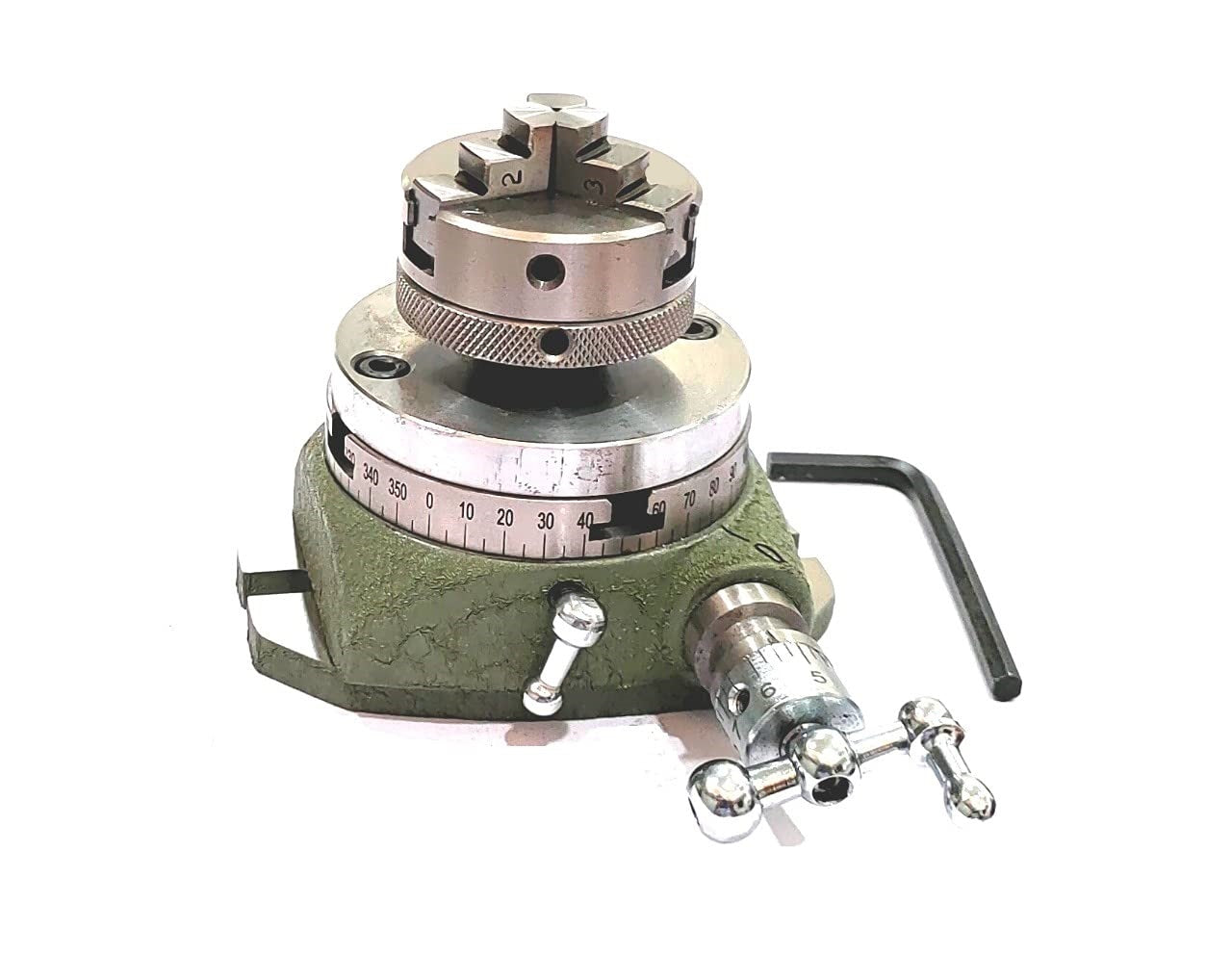
The 3-inch (80mm) rotary table is the compact end of the mainstream range, and it is the natural match for benchtop mills and mini mill setups where table space and travel are limited. Typical 3-inch tables come in both regular and tilting versions with 3-slot or 4-slot table surfaces, and many pair naturally with a small round vice or an ER collet adaptor for gripping small round stock directly on the table's axis.
This size is a favorite among hobbyists and model makers working on scale engine parts, small brackets, and instrument components, and an even smaller 2.75-inch watchmaker's variant exists specifically for the ultra-fine end of the spectrum, popular in the watchmaker's tool range, where parts are measured in millimeters, not inches.
Best for: Benchtop and mini mills, watch and instrument work, model engineering, small parts under roughly 3 inches across, and anyone prioritizing lightweight and easy handling over raw capacity.
The 4 Inch Table: The Sweet Spot
The most popular size for good reason.
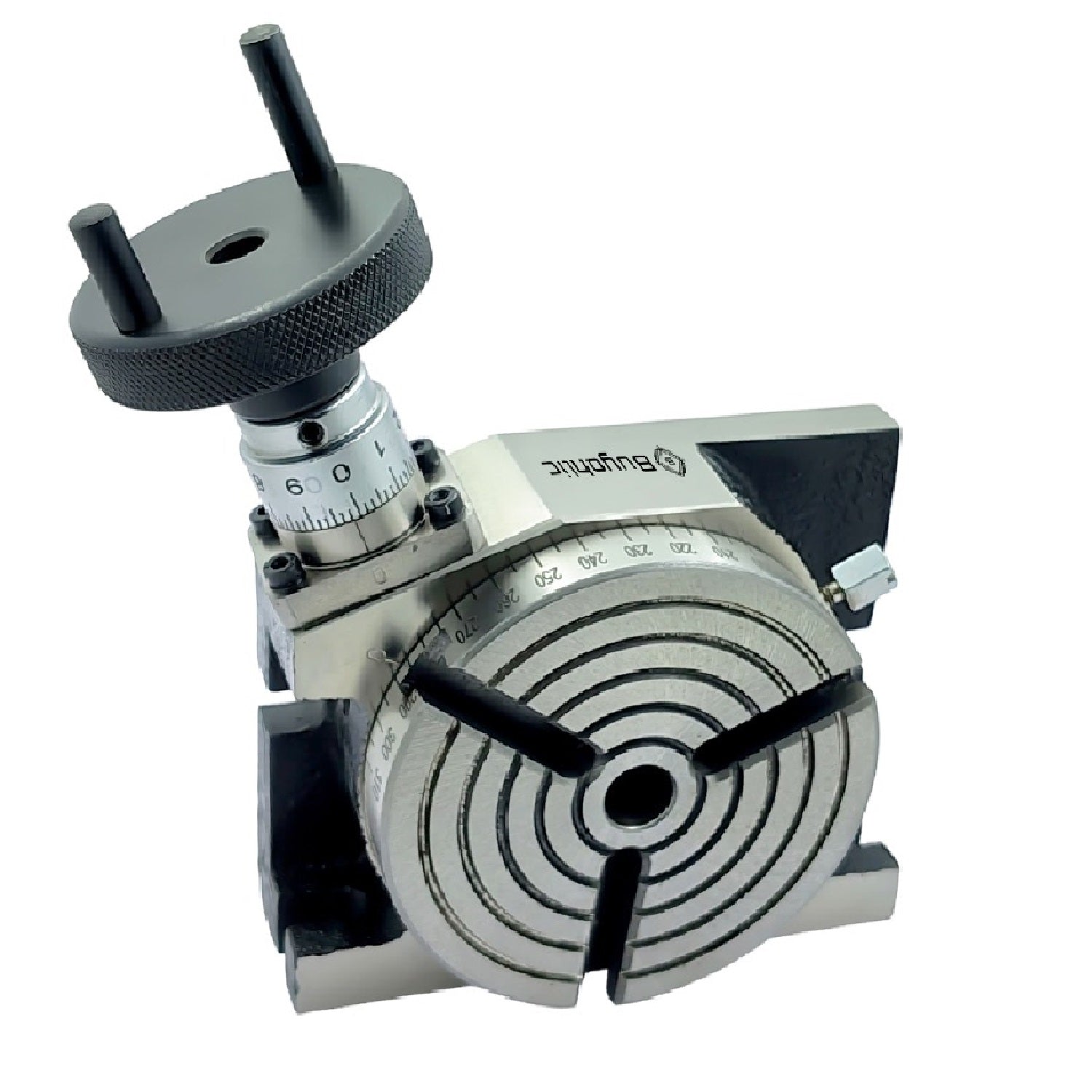
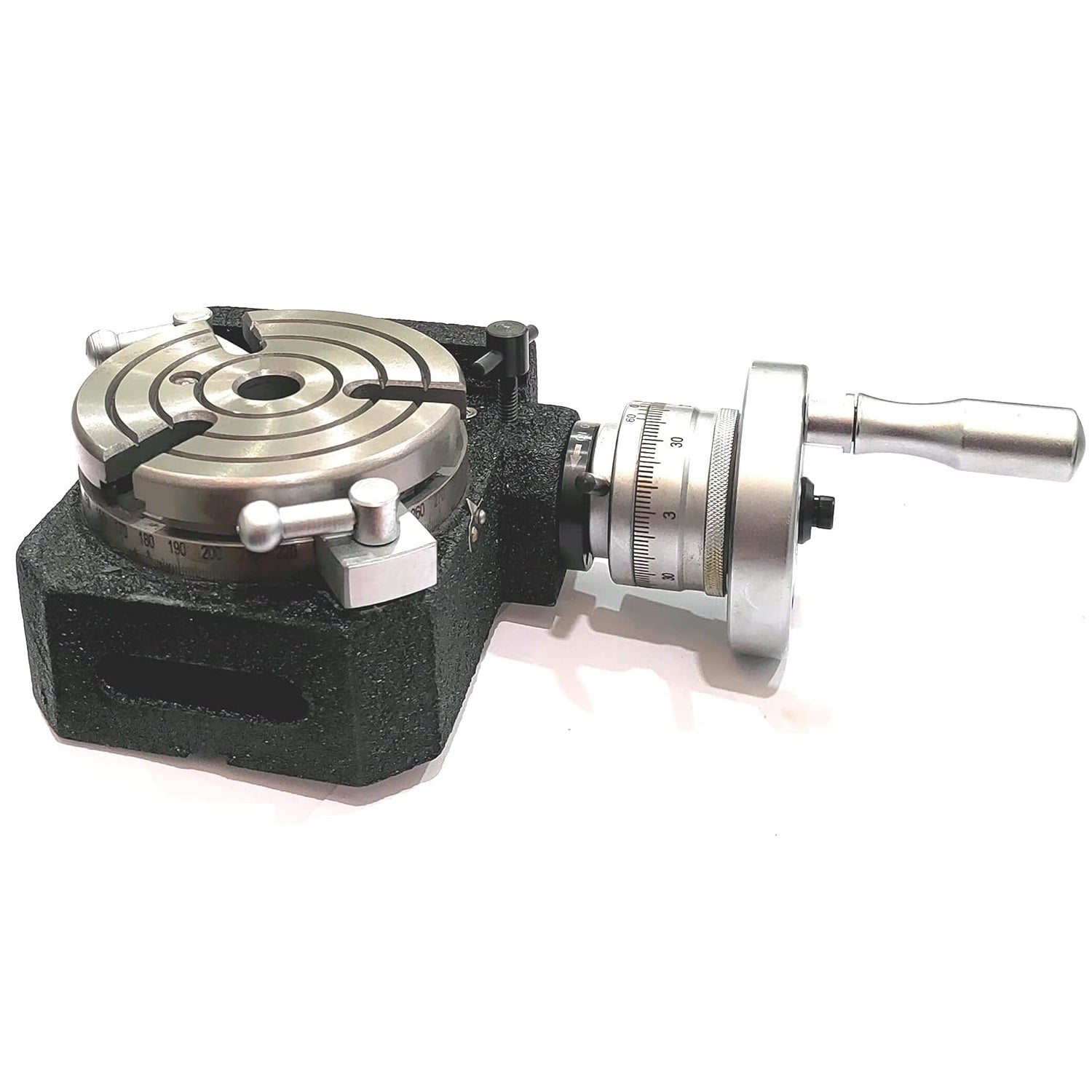
The 4-inch class (spanning roughly 100 to 110mm table diameters) is where most home shop machinists land, and it earns that position honestly. It is large enough to handle the majority of real-world small shop parts, small enough to remain manageable on a mid-size benchtop or knee mill, and it is the size where useful features become standard rather than optional extras.
The most important of those features is the MT2 center bore, a Morse Taper socket through the table's center that accepts centers, adapters, and arbors directly on the rotational axis. Combined with horizontal-vertical (HV) mounting, which lets the same table work flat on the mill table or stood up on its side, and available tilting bases for compound-angle work, a well-equipped 4-inch table covers an enormous range of setups. Pairing it with a small chuck from the back plates and chuck range effectively turns it into a rotating workholding station.
Best for: The widest range of general shop work, bolt hole circles, arc milling, indexed drilling, and anyone who wants one table that covers most jobs without specializing in either extreme.
The 6 Inch Table: Serious Capacity
For gear cutting, larger parts, and full indexing setups.
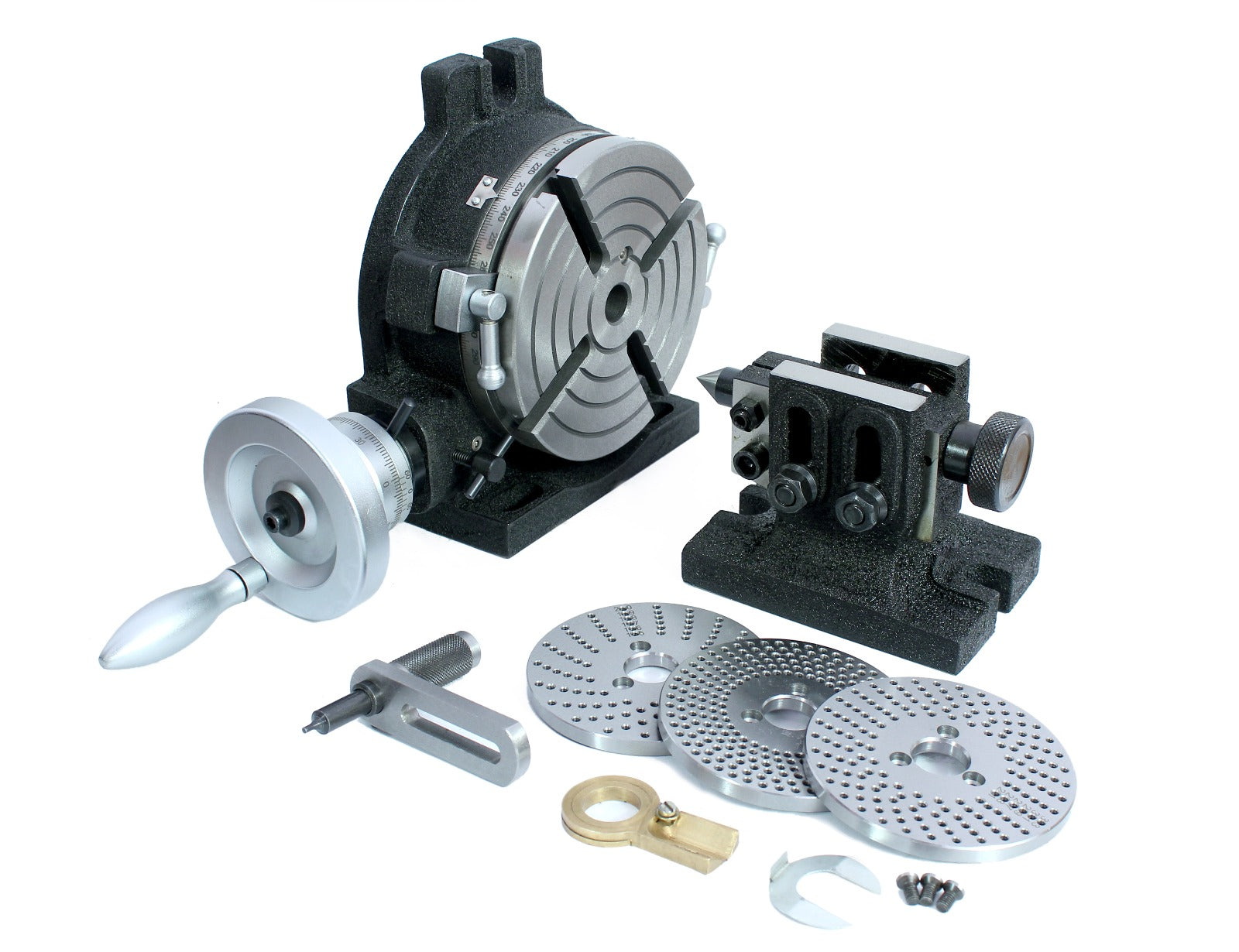
The 6-inch (150mm) table, commonly designated HV6, is where rotary work starts to feel like real production capability. The larger surface supports bigger workpieces without overhang, typically carries a 4-slot table for more flexible clamping, and its greater mass adds rigidity that directly improves finish quality on heavier cuts. This is the size favored in the heavy-duty and industrial end of the range.
Crucially, the 6-inch size is where full indexing setups become standard: HV6 tables are commonly sold as complete packages with a tailstock for supporting long work between centers and a set of dividing plates for precise angular indexing, exactly the combination gear cutting and other tooth-count work demands. The tradeoff is weight and footprint: a 6-inch table with accessories is a genuine two-hand lift and consumes meaningful space on smaller machines.
Best for: Gear cutting with dividing plates, larger workpieces, between-centers indexing with a tailstock, and shops with a full-size mill that can spare the table space and travel.
3" vs 4" vs 6": Full Comparison
Here is how the three sizes stack up across the factors that actually drive the buying decision.
| Factor | 3" (80mm) | 4" (100-110mm) | 6" (150mm) |
|---|---|---|---|
| Best Machine Match | Mini and benchtop mills | Benchtop and knee mills | Full-size knee mills |
| Typical Slot Count | 3 or 4 slots | 3 or 4 slots | 4 slots |
| MT2 Center Bore | On select models | Commonly available | Standard |
| Tailstock and Dividing Plate Kits | Rare | Available | Commonly bundled |
| Portability | Excellent, one-hand lift | Good | Heavy, two-hand lift |
| Typical Price Range at Buyohlic | Roughly $54 to $103 | Roughly $120 to $160 | Roughly $299 with full kit |
| Best Use | Small parts, model work | General shop versatility | Gear cutting, larger parts |
Quick Recommendation: Running a mini mill or doing fine model work? The 3-inch is your match. Want one table that handles nearly everything? The 4-inch with an MT2 bore is the proven sweet spot. Planning gear cutting or larger indexed work? Go straight to the 6-inch with tailstock and dividing plates and skip the upgrade cycle entirely.
Features That Matter at Any Size
Beyond diameter, these are the specs worth checking before you buy.
HV (Horizontal-Vertical) Mounting
Let's use the same table work flat for face work or stand vertically for cutting around a part's circumference, effectively two tables in one.
MT2 Center Bore
A Morse Taper socket through the table center that accepts centers and arbors directly on the rotation axis, essential for concentric setups.
Tilting Base Option
Adds a third axis of adjustment for compound-angle work that a standard flat or HV table cannot reach on its own.
Worm Gear Quality
The worm drive determines backlash and indexing accuracy; a smooth, low-backlash worm matters more to real accuracy than any single other spec.
Accessories Worth Pairing
The table is the platform; accessories are what make it productive.
A bare rotary table can only clamp what fits its T-slots directly. The rotary table accessories range is what expands that into a complete rotational workholding system, and a few pairings stand out at each size:
- A clamp kit is the first accessory for any size, giving you the studs, nuts, and step blocks to secure irregular workpieces directly to the T-slots.
- An ER collet adaptor mounts in the center bore and grips round stock concentrically on the table's axis, especially useful on 3 and 4-inch tables working with small round parts.
- A chuck with a matching back plate turns the table into a rotating chuck station, with 50mm, 65mm, and 70mm chucks commonly paired with the smaller table sizes.
- Dividing plates and a tailstock complete a full indexing setup, most commonly bundled with the 6-inch HV6 for gear cutting and between-centers work.
Which Size Should You Buy?
Answer three questions, and the choice usually makes itself.
Quick Selection Guide
| Mini mill or benchtop machine? | Choose a 3 Inch Table |
| Watch, instrument, or miniature work? | Choose a 2.75" or 3 Inch Table |
| One table for general shop work? | Choose a 4 Inch with MT2 Bore |
| Compound-angle features on parts? | Choose a Tilting 3 or 4 Inch |
| Gear cutting or larger indexed parts? | Choose a 6 Inch with Dividing Plates & Tailstock |
Featured Rotary Tables
One representative option from each size class in the Buyohlic rotary tables range, from watchmaker scale up to the full 6-inch indexing kit.
The Bottom Line
There is no single best rotary table size, only the right size for your machine, your parts, and your patience for lifting heavy fixtures. The 3-inch wins on compactness for benchtop and fine work, the 4-inch earns its reputation as the do-everything sweet spot, and the 6-inch delivers the capacity and full indexing kit that gear cutting and larger work genuinely require.
Whichever size fits your shop, budget for a clamp kit from day one, add accessories as the work demands, and the table will pay for itself across years of arcs, bolt circles, and indexed features no plain mill setup could touch.
Ready to Add a Rotational Axis to Your Mill?
Buyohlic supplies rotary tables in every mainstream size alongside the full range of chucks, clamp kits, dividing plates, and tailstocks to complete your setup. Quality guaranteed, fast US shipping.
Shop Rotary Tables NowAbout Buyohlic
Buyohlic is your trusted source for premium industrial tools, cutting tools, and precision measuring instruments. With decades of experience serving machinists, engineers, and manufacturers, we're committed to supplying tools that professionals depend on for accuracy, durability, and reliability.
Every tool in our catalog is selected for quality and backed by our commitment to customer satisfaction. Fast shipping, expert support, and competitive pricing make Buyohlic your one-stop shop for precision milling, turning, and measurement tools.
Frequently Asked Questions
What size rotary table should I buy for a mini mill?
What is the difference between 4-inch and 6-inch rotary tables?
Do I need an MT2 center bore on my rotary table?
What accessories do I need alongside a rotary table?
Can a rotary table be used vertically as well as flat?
Is a bigger rotary table always better?


Great Value
Most popular brands with widest range of selection at best prices.

Nationwide Delivery
Over 20,000 pincodes serviceable across India.

Secure Payment
Partnered with India's most popular and secure payment solutions.

Buyer Protection
Committed to buyer interests to provide a smooth shopping experience.