

Best Tap and Die Sets for American Machine Shops — 2026 Guide
- , by Mani Bhushan
- 16 min reading time
"A broken tap inside a precision-machined part can destroy hours of work in seconds." That’s exactly why professional American machine shops never compromise on tap and die quality.
Whether you're restoring damaged threads, creating new threaded holes, or handling precision CNC work, a high-quality tap and die set is one of the most important tool investments for any machine shop. In modern American workshops, threading accuracy directly affects assembly strength, production quality, and long-term reliability.
This 2026 guide explains the best tap and die sets for American machine shops, how these threading tools work, what materials professionals prefer, and which Buyohlic tools are best for industrial machining environments.
01 What Is a Tap and Die Set?
A tap and die set is a collection of threading tools used to create or repair screw threads on metal components.
Taps cut internal threads inside holes, while dies cut external threads on rods or bolts. Together, these tools allow machinists to create perfectly matching threaded connections for mechanical assemblies.
Machine shops across the United States use tap and die tools for:
- Automotive repair
- CNC machining
- Fabrication work
- Industrial maintenance
- Hydraulic systems
- Aerospace components
- Thread restoration
Quick Tip: Professional machinists almost always keep both SAE and Metric tap and die sets in the workshop because American and imported machines often use different threading standards.
02 Why Thread Quality Matters in Machine Shops
In modern machine shops, thread quality is crucial because threaded parts are used in nearly every mechanical assembly. From CNC-machined parts and automotive systems to industrial machinery and fabrication, accurately cut threads ensure strong connections, accurate assembly, and long-term reliability.
Poor thread quality can cause serious machining and operational problems, especially in high-precision industries where even a small error can lead to part failure or costly downtime.
High-quality threads help machine shops achieve:
- Strong and secure fastening
- Better assembly accuracy
- Smooth bolt and nut engagement
- Reduced vibration during operation
- Improved load-holding strength
- Longer component lifespan
- Better machining consistency
- Reduced wear on fasteners
- Easier assembly and maintenance
- Improved product reliability
Poor thread quality can cause:
- Loose fasteners
- Thread stripping
- Hydraulic or air leakage
- Crooked assembly alignment
- Damaged machine components
- Excessive vibration
- Poor fitting of bolts and nuts
- Production delays
- Rejected machined parts
- Increased maintenance costs
- Expensive rework
- Machine downtime
In industries such as aerospace, automotive, manufacturing, and CNC machining, precision threading is crucial because poor or incorrect threads can impact safety, performance, and production quality. Therefore, professional machinists use high-quality tap and die sets, the right cutting fluid, and precise threading techniques to maintain reliable machining standards.
American machine shops place a particular focus on thread accuracy because modern production environments require tight tolerances, repeatable machining quality, and durable threaded connections for industrial applications.
⚠ One broken tap can ruin an expensive part: Cheap carbon steel taps often snap inside hardened material. Removing a broken tap from a finished workpiece is time-consuming and sometimes impossible.
03 Understanding Different Types of Taps
Different types of taps are designed for specific threading operations, materials, and machining conditions. Choosing the right tap improves thread quality, reduces tool breakage, and increases machining efficiency in both manual and CNC machine shops.
Professional machinists use different tap styles depending on whether the hole is blind or through, the material being machined, and the required thread finish.
Taper Tap
A taper tap has a gradual cutting lead with several chamfered threads at the tip, making it easier to start threading operations smoothly.
Best For:
- Starting new threads
- Hand tapping operations
- Beginner-friendly threading
Advantages:
- Smooth thread engagement
- Lower risk of tap breakage
- Better alignment during starting
Plug Tap
Plug taps are the most commonly used taps in workshops and machine shops. They provide a balanced cutting action suitable for general-purpose threading work.
Best For:
- General machining work
- Repair and maintenance
- Workshop on threading applications
Advantages:
- Faster threading
- Good balance between cutting and finishing
- Suitable for most materials
Bottoming Tap
Bottoming taps are designed to cut threads close to the bottom of blind holes. They have very little taper at the cutting end.
Best For:
- Blind holes
- Deep threading applications
- Precision finishing work
Advantages:
- Maximum thread depth
- Better thread completion near the hole bottom
- Accurate finishing
Spiral Flute Tap
Spiral flute taps pull chips upward and out of the hole during cutting. These taps are especially useful for blind-hole threading.
Best For:
- Blind holes
- Soft materials
- CNC machining operations
Advantages:
- Better chip evacuation
- Cleaner thread finish
- Reduced chip clogging
Spiral Point Tap
Spiral point taps push chips forward instead of pulling them upward. They are widely used in production machining.
Best For:
- Through holes
- High-speed threading
- CNC production work
Advantages:
- Faster cutting
- Smooth chip flow
- Improved productivity
Pipe Tap
Pipe taps are specially designed for cutting tapered threads used in pipe fittings and plumbing connections.
Best For:
- Pipe threading
- Hydraulic fittings
- Pneumatic systems
Advantages:
- Leak-resistant threaded connections
- Accurate pipe fitting threads
- Strong sealing performance
Machine Tap
Machine taps are designed specifically for powered tapping operations on drill presses, CNC machines, and tapping machines.
Best For:
- Production machining
- Automated threading
- Industrial manufacturing
Advantages:
- Faster threading operations
- Consistent thread quality
- Higher production efficiency
Hand Tap Set
A standard hand tap set usually includes:
- Taper Tap
- Plug Tap
- Bottoming Tap
These three taps are commonly used together for accurate manual threading operations in machine shops and repair work.
04 Types of Dies Used in Machine Shops
Dies are cutting tools used to create or repair external threads on rods, bolts, pipes, and cylindrical parts. In the machine shop, different types of dies are used depending on the threading application, material type, and required thread accuracy.
Professional machinists use a variety of die styles for maintenance work, fabrication, automotive repair, CNC machining, and industrial production.
Round Dies
Round dies are the most commonly used threading dies in workshops and machine shops. They are circular in shape and used for cutting external threads on rods and shafts.
- Most common die style
- Easy to use
- General workshop threading
- Affordable and reliable
Adjustable Dies
Adjustable dies allow slight adjustment in thread size and cutting pressure. These are useful when repairing worn or damaged threads.
- Allows thread size adjustment
- Useful for repair work
- Better control over fit
- Common in industrial maintenance
Hex Dies
Hex dies are compact threading dies designed with a hexagonal outer shape so they can be operated using standard wrenches.
- Compact threading design
- Works with standard wrenches
- Great for field repairs
Machine Dies
Machine dies are designed for powered threading operations in CNC machines and production environments.
- Designed for production threading
- Used in CNC operations
- High consistency and speed
05 Metric vs SAE Tap and Die Sets
| Feature | Metric Set | SAE Set |
|---|---|---|
| Measurement | Millimeters | Inches |
| Common Use | Modern imported machinery | American automotive & industrial |
| Popular Sizes | M6, M8, M10 | 1/4"-20, 3/8"-16 |
| Workshop Need | CNC & imported equipment | Traditional US machinery |
Most professional American machine shops maintain both systems to handle a wide range of threading requirements.
06 Best Materials for Tap and Die Sets
The material used in a tap and die set is a major factor in threading performance, durability, cutting speed, and tool life. Professional machine shops select threading tools based on the material being machined, production volume, and required thread accuracy.
High-quality tap and die materials improve thread finish, reduce breakage, and provide better resistance to heat and wear during machining operations.
High-Speed Steel (HSS)
High-speed steel is the most commonly used material for professional tap and die sets. It offers an excellent balance of strength, durability, and cutting performance.
- Excellent durability
- Long cutting life
- Good heat resistance
- Works well on steel and aluminum
Carbon Steel
Carbon steel tap and die sets are commonly found in inexpensive or beginner tool kits. These tools are suitable for occasional use but not for heavy industrial work.
- Affordable
- Lower durability
- Not ideal for production work
Cobalt Threading Tools
Cobalt tap and die sets are designed for machining hard metals and high-temperature applications. They offer very good wear resistance and durability.
- Superior heat resistance
- Excellent for stainless steel
- Long-lasting under heavy use
Professional Recommendation: For serious machine shop use in 2026, HSS or cobalt tap and die sets provide the best long-term value and reliability.
07 Buyohlic Professional Threading Tools
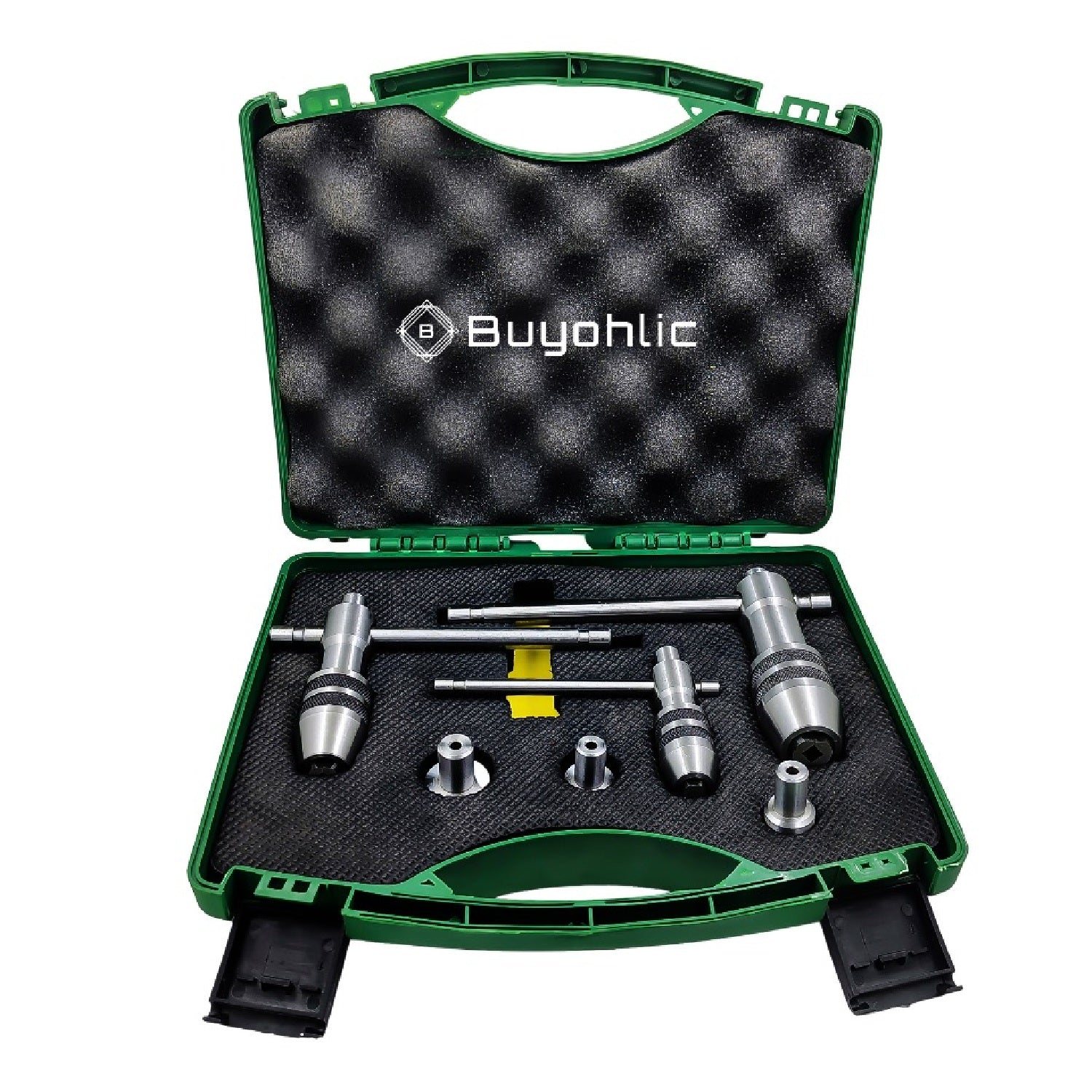
Buyohlic Threading Tools
Professional Tap and Die Sets for Machine Shops
Industrial-grade threading tools designed for CNC shops, fabrication workshops, automotive repair, and precision engineering applications. Available in Metric, SAE, and combined professional sets.
Shop Tap & Die Sets →
Buyohlic threading tools are designed for real workshop environments where durability, accuracy, and productivity matter every day.
08 How Professionals Use Tap and Die Sets
Professional machinists use taps and die sets to create, repair, and restore threads in precision machining, fabrication, automotive repair, and industrial maintenance. In a modern machine shop, proper threading technique is crucial because thread quality directly impacts the strength, alignment, and long-term reliability of an assembly.
Experienced machinists follow a meticulous process to ensure accurate and damage-free threading operations.
Step 1: Drill Correct Hole Size
The tap drill size must match the thread specification accurately.
Step 2: Use Cutting Oil
Lubrication reduces heat and improves thread quality.
Step 3: Maintain Proper Alignment
Crooked threading ruins both the hole and the fastener.
Step 4: Reverse Periodically
Backing off breaks chips and prevents binding.
Step 5: Avoid Excessive Force
Forcing the tap increases breakage risk dramatically.
09 Common Threading Mistakes That Damage Parts
Threading may seem like a simple machining operation, but even small mistakes can damage expensive components, ruin thread accuracy, and reduce assembly reliability. Professional machine shops follow proper threading techniques because poor threading can lead to part rejection, machine downtime, and costly repairs.
Understanding the most common threading mistakes helps machinists improve thread quality, protect tools, and maintain machining precision.
Using the Wrong Drill Size
- Poor thread fit
- Weak threads
- Higher breakage risk
No Lubrication
- Excess heat
- Damaged cutting edges
- Rough thread finish
Using Cheap Tools
- Short tool life
- Inconsistent threading
- Broken taps
Incorrect Alignment
- Crooked threads
- Fastener binding
- Assembly failure
10 Best Tap and Die Sets for Different Applications
| Application | Recommended Tool Type |
|---|---|
| Automotive Repair | SAE HSS Tap & Die Set |
| CNC Machining | Spiral Flute & Spiral Point Sets |
| General Workshop Use | Combined Metric + SAE Set |
| Stainless Steel Threading | Cobalt Threading Tools |
| Industrial Maintenance | Heavy-Duty Adjustable Die Sets |
11 Recommended Related Products
- Drill Bits
- Tap Wrenches
- Cutting Fluids
- Thread Gauges
- Reamers
- Collet Systems
- Machining Tools
- Precision Measuring Tools
- Tool Holders
Complete Workshop Setup: Professional machinists usually combine threading tools with precision measuring tools and quality drilling equipment for better machining accuracy.
Final Verdict: Which Tap and Die Set Should You Buy in 2026?
For DIY and occasional repair work: A medium-size HSS tap and die set provides good value and versatility.
For professional American machine shops: Precision-ground HSS or cobalt threading tools deliver the best performance, thread quality, and long-term durability.
For CNC and production environments: Spiral flute and spiral point threading systems improve speed, chip evacuation, and consistency.
Buyohlic offers professional threading tools, tap and die sets, spiral flute taps, machining accessories, and industrial workshop solutions designed for serious machinists, fabrication professionals, and modern American machine shops.
Frequently Asked Questions
What is the best material for a tap and die set?
Do American machine shops use SAE or Metric tap sets?
What causes taps to break?
Are cheap tap and die sets worth buying?


Great Value
Most popular brands with widest range of selection at best prices.

Nationwide Delivery
Over 20,000 pincodes serviceable across India.

Secure Payment
Partnered with India's most popular and secure payment solutions.

Buyer Protection
Committed to buyer interests to provide a smooth shopping experience.