

Woodworking vs Metalworking Vises: What's the Real Difference?
- , by Mani Bhushan
- 21 min reading time
"Can't I just use my bench vise for both?" Every new shop owner asks this. The answer is: technically yes, practically no, and the reason why tells you everything about how these two tools are built.
A woodworking vise and a metalworking vise look similar from across the garage. Both have two jaws, a leadscrew, and a handle. But put them side by side, and the differences become obvious. Use the wrong one for the wrong material, and you'll either dent your workpiece, strip your threads, or crack your vise body. This guide explains exactly what separates them and which Buyohlic vises belong in your shop.
01 The One Sentence That Explains Everything
Here it is: a woodworking vise is designed to protect the workpiece. A metalworking vise is designed to resist the tool.
Wood is soft, easily dented, and damaged by hard metal jaws. So woodworking vises use large, wide wooden jaw faces, sometimes 12 to 18 inches wide, that distribute clamping force across a broad area and grip without biting in. The whole engineering priority is not marking the surface.
Metal is hard, doesn't dent from jaw pressure, and needs to be held absolutely immovably against filing, grinding, and cutting forces that try to push and rotate it. Metalworking vises use hardened, serrated steel jaw faces that bite into the workpiece, deliberately creating a mechanical grip that doesn't slip under load. The whole engineering priority is holding a position under force.
Two completely different problems. Two completely different tools.
🪵 Woodworking Vise
Protect the surface
- Wide wooden or composite jaw faces
- Low clamping pressure distributed evenly
- Mounted flush with or below the bench top
- Usually, no rotation or swivel base
- Light cast iron or wood body construction
- Large, rapid-action jaw movement for boards
- Designed for planing, sawing, chiseling, and routing
02 Woodworking Vises: Built Around the Board
Walk into any serious woodworking shop in America, and the front vise on the workbench is almost always a face vise mounted to the left front edge of the bench (for right-handed workers), jaw faces flush with the bench top, with a dog hole system for end work. This positioning is deliberate.
When you're planning a long board, sawing a joint, or paring a dovetail, you need the workpiece supported at bench height, not lifted above it. A woodworking vise delivers this by being part of the bench itself, not just bolted to its top.
Key features that woodworking vises have that metalworking vises don't have
- Wooden jaw faces (or soft composite faces): The inner face of both jaws is lined with wood, typically hardwood or MDF. This is the most important feature: it distributes pressure without leaving jaw marks in the surface. On a metalworking vise, these same surfaces are hardened and serrated specifically to grip using one on finished wood leaves permanent parallel score marks.
- Very wide jaw width: Woodworking face vises often have jaws 9 to 12 inches wide or more. This wide span prevents the workpiece from racking (tilting in the jaw) when clamped off-center, which happens constantly when holding cabinet doors, drawer fronts, and wide panels.
- Rapid action / quick release: A button or cam mechanism that disengages the leadscrew and lets the movable jaw slide freely. This matters enormously when you're moving from a 1-inch pencil to a 10-inch board all day long. Without quick release, you spin the handle 40 times between every piece.
- Dog holes and bench dogs: Many woodworking vises have holes in the moving jaw that align with matching holes in the bench top. Steel or wooden bench dogs pop up through these holes to stop the far end of a long board from sliding while the vise clamps the near end. This system holds long stock flat on the bench surface for hand planing, something no metalworking vise can replicate.
💡 The flush-mount detail matters: A woodworking face vise installs so its outer jaw face is flush with the front of the bench. This means when you're hand-planing a board edge while it's in the vise, your plane iron doesn't run into the vise hardware. Every feature of a woodworking vise is designed around how woodworkers actually work, which is why putting a metalworking bench vise on a woodworking bench is always a frustrating compromise.
03 Metalworking Bench Vises: Built to Take a Beating
A metalworking bench vise, which most people picture when they hear the word "vise" is engineered around a completely different set of forces. When you're filing steel, you're pushing with 15–30 pounds of force in a direction that tries to rotate the workpiece in the jaws. When you're bending bar stock, you're applying enormous leverage. When you're striking a cold chisel, you're transmitting hammer impact directly through the jaws into the vise body.
None of these applications is kind to tooling. The metalworking bench vise is built to absorb all of it without flinching.
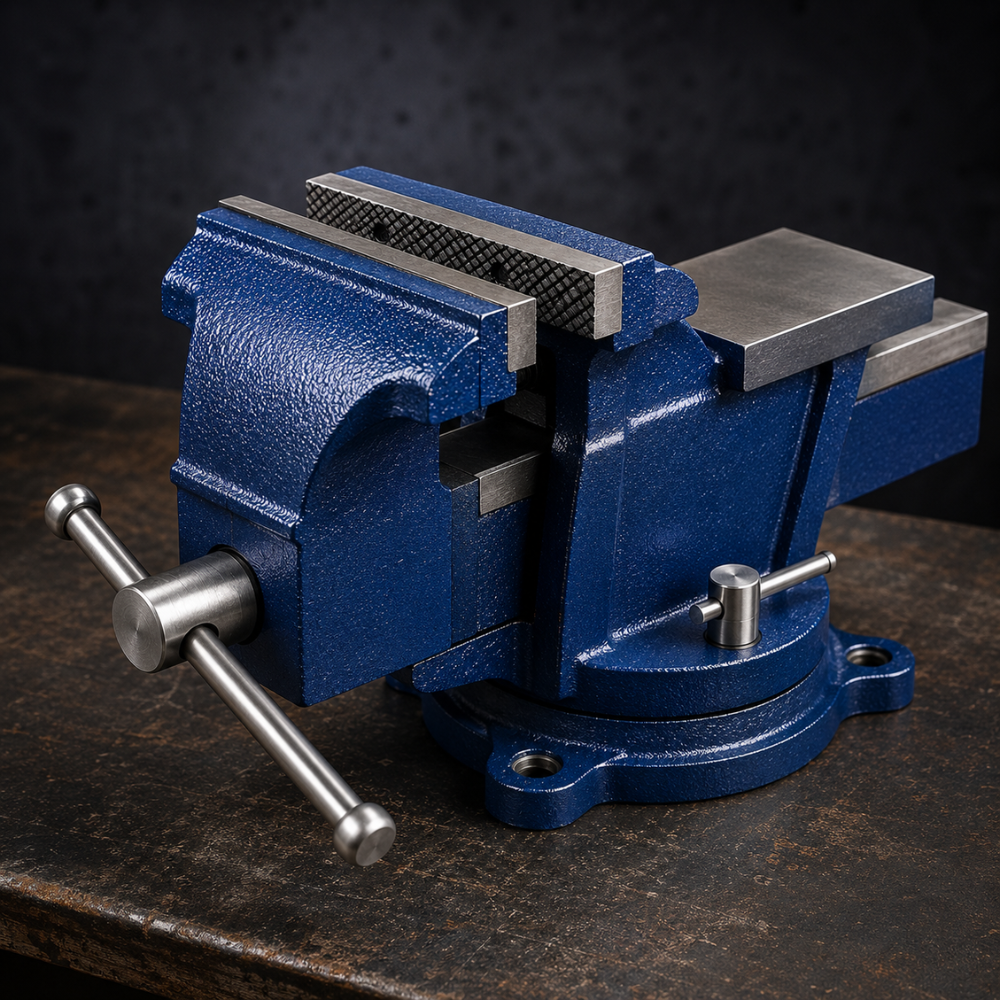
Buyohlic Vices & Workholding
Engineer's Bench Vises: Heavy Duty Range
Heavy cast iron body, hardened serrated steel jaws, 360° swivel base, and built-in anvil pad. Available in multiple jaw widths from 4" to 6". Ships from our US warehouse with free shipping on all orders.
Shop Bench Vises →
What makes a metalworking vise different in construction
- Hardened, serrated jaw inserts: The jaw faces are separate hardened steel inserts (not the body itself) that are bolted in and replaceable when worn. The serrations bite into metal deliberately, creating a grip that doesn't slip under filing or grinding forces. These same serrations would permanently scar any wood surface.
- 360° swivel base: The vise body rotates on a cast base, allowing you to reposition the workpiece relative to your filing direction without unclamping it. Most metalworking vises have a locking lever or bolt that locks the swivel at any angle. Woodworking vises are fixed; you position the wood, not the vise.
- Built-in anvil: The rear of most engineers' bench vises includes a flat, hardened anvil pad. This is where you strike cold chisels, punch rivets, and do light hammer forming work. No woodworking vise has this feature; it would crack the light castings used in wood vise construction.
- Pipe jaw grooves: Many metalworking vises have V-grooves machined into the bottom of the fixed jaw to hold round stock and pipe without it rotating. Woodworking vises have no equivalent; round stock in a wood vise's flat wooden jaws will simply spin.
- Massive weight and clamping force: A quality 6-inch engineer's bench vise weighs 30 to 60 pounds and can apply clamping forces exceeding 3,000 pounds. This mass provides inertia that prevents the vise from moving during hammer blows. A woodworking vise weighs 8 to 20 pounds, not designed for impact.
Pro tip: Protecting metal vise jaws: Keep a set of shop-made soft jaw liners (flat pieces of 1/2" hardwood or aluminum sheet) beside your bench vise. When you need to hold finished metal parts, soft copper tubing, or anything that can't be marked, drop the liners over the steel jaw faces before clamping. Three-second swap, no marring. This one habit makes a metalworking vise nearly as versatile as a woodworking vise for delicate work.
04 Full Comparison — Every Spec That Matters
| Feature | Woodworking Vise | Metalworking Bench Vise |
|---|---|---|
| Jaw face material | Wood (hardwood or MDF liner), soft, non-marring | Hardened serrated steel inserts, grip-first design |
| Jaw width | 9" to 18"+ wide for boards and panels | 3" to 8" sized for metal stock and small parts |
| Body material | Light cast iron or steel, not rated for impact | Heavy-duty cast iron rated for hammer blows |
| Swivel base | No, fixed mount, flush with the bench | Yes, 360° swivel with locking lever on most models |
| Quick release | Yes, essential for changing board sizes quickly | Available on some models, less common |
| Anvil pad | No | Yes, hardened rear surface for light forming work |
| Pipe jaw grooves | No | Yes, V-grooves for round stock on most models |
| Bench dog holes | Yes, for face planing long boards flat on the bench | No |
| Mounting position | Front face of bench, flush with bench top | Top of the bench, bolted through the bench top |
| Typical weight | 8–20 lbs | 25–65 lbs |
| Max clamping force | Low designed for wood compression | High 2,000–4,000+ lbs on 6" models |
| Best for | Planing, sawing, chiseling, routing, carving, joinery | Filing, grinding, bending, cutting, assembly, and welding prep |
| Will it mark wood? | No, designed specifically not to | Yes, serrated jaws leave deep score marks |
| Will it hold metal under filing? | No, jaws slip, body too light. | Yes, serrated hardened jaws grip firmly |
05 Beyond the Basics: Specialized Vise Types You Should Know
Once you move past the standard bench vise, both the woodworking and metalworking worlds have a range of specialized vises built for specific jobs. Here's what actually matters for most US shops:
On the metalworking side

Buyohlic CNC & VMC Tools
Precision Milling Vises: VMC & CNC Range
Not a bench vise, these mount directly to CNC and VMC milling machine tables. Hardened ground jaws to ±0.02mm, automatic pull-down mechanism, modular design. The correct vise for any milling machine operation. Ships from our US warehouse.
Shop Milling Vises →
- Precision milling vise (machine vise): This is not a bench vise at all. It mounts on the table of a milling machine or VMC and is engineered to withstand cutting forces from end mills and face mills. Jaws ground to within 0.001" or better. Buyohlic's precision milling vise range covers 4", 6", and 8" jaw widths for mini mills through full industrial VMC machines.
- Drill press vise: Lighter than a bench vise, designed for clamping work on a drill press table during drilling. Lower clamping force, but with a flat ground base that sits stably on the drill press table. See Buyohlic drill press vises.
- Angle vise: A precision vise with a tilting body, used for milling or grinding workpieces at a set angle. See Buyohlic angle vises.
- Steel grinding vise: Ultra-precise, ground flat on all surfaces for use on surface grinders. Holds workpieces with extremely low profiles for grinding operations. See Buyohlic steel grinding vises.
Buyohlic Vices & Workholding: Full Range
Browse All Vises →
Bench vises, milling vises, angle vises, drill press vises, and grinding vises ship from our US warehouse.
06 Okay: Which One Do YOU Actually Need?
Stop overthinking it. Here's the honest answer based on what you're actually doing in your shop:
Buy a Woodworking Vise if:
- You build furniture, cabinets, or do joinery
- You hand-plane boards or shape wood by hand
- You cut dovetails, mortises, or wood joints
- Surface marks on your workpiece are unacceptable
- You work with long boards that need bench dog support
- Do you do any kind of woodturning blank prep or carving
Running a mixed shop (wood AND metal)? The honest answer is one of each mounted at separate bench stations if space allows, or on a rolling tool cart that you bring to whichever bench you need. A quality metalworking bench vise with wooden soft jaw liners handles about 80% of woodworking tasks reasonably well. The only operation it truly can't replace is face planing long boards flat on the bench that genuinely needs a proper woodworking face vise. Buy the metalworking vise first; add the wood vise when your projects demand it.
07 Installing and Maintaining Your Vise: What Most People Get Wrong
The most common bench vise mistake in US home shops: mounting it in the wrong place. Your vise should be mounted at the left front corner of the bench (for right-handed users) so you can work comfortably on long pieces extending to the right. Most people mount it dead center, which makes everything awkward and limits jaw access.
The second most common mistake: not bolting it down properly. A 6-inch metalworking vise applying 3,000 pounds of clamping force to a workpiece wants to lift off the bench. Use four bolts through the bench top, with large washers underneath. Bolts should be at least 3/8" in diameter. Anything less and the vise shifts under hard filing, the vibration drives you crazy, and the resulting scratch marks on your work are infuriating.
⚠ One thing that ruins most bench vises prematurely: leaving them outdoors or near open windows without protection. Cast iron corrodes fast in humid conditions. Wipe the exposed jaw faces and screw threads with a light coat of oil every few months. This five-minute task keeps a vise lasting decades rather than years. Use any light machine oil from an oil can; nothing special is required.
The Real Difference: One Sentence Each
Woodworking vise: Wide wooden jaws, flush bench mount, quick release, bench dog holes engineered to hold wood without marking it while your hands do the cutting.
Metalworking bench vise: Hardened serrated steel jaws, swivel base, anvil pad, pipe grooves engineered to hold metal immovably against the forces of files, grinders, and hammers.
Precision milling vise: Ground jaws to 0.001" accuracy, mounts on machine table engineered to hold metal against the cutting forces of end mills and face mills on CNC and VMC machines. Not a bench tool at all.
Buyohlic carries all three types, all shipped from our US warehouse with free shipping. If you're not sure which specific model fits your machine or bench, browse our complete vises and workholding range or contact our team before ordering.
More From Buyohlic's Workholding Range
- Bench Vices: Heavy-duty engineer's range for metalworking and general shop use
- Baby Bench Vices: Compact bench vises for light work, small shops, and hobbyists
- Engineer's Range Vices: Full professional engineer's vise selection
- Precision Milling Vises: For CNC and VMC machine table mounting
- Drill Press Vises: For stable workholding on drill presses
- Angle Vices: Tilting body for angled milling and grinding
- Steel Grinding Vices: Precision ground for surface grinder use
- Clamping Tools: Step blocks, clamp kits, toolmaker's clamps for all workholding
- Angle Plates: For squaring and vertical workholding alongside vises
- Woodworking Tools: planes, saws, chisels, and clamps for your woodworking bench
Frequently Asked Questions
Can I use a metalworking bench vise for woodworking?
Can I use a woodworking vise for metalworking?
What is the difference between a bench vise and a milling vise?
How do I choose the right size bench vise?
What is a quick-release vise, and do I need one?


Great Value
Most popular brands with widest range of selection at best prices.

Nationwide Delivery
Over 20,000 pincodes serviceable across India.

Secure Payment
Partnered with India's most popular and secure payment solutions.

Buyer Protection
Committed to buyer interests to provide a smooth shopping experience.