


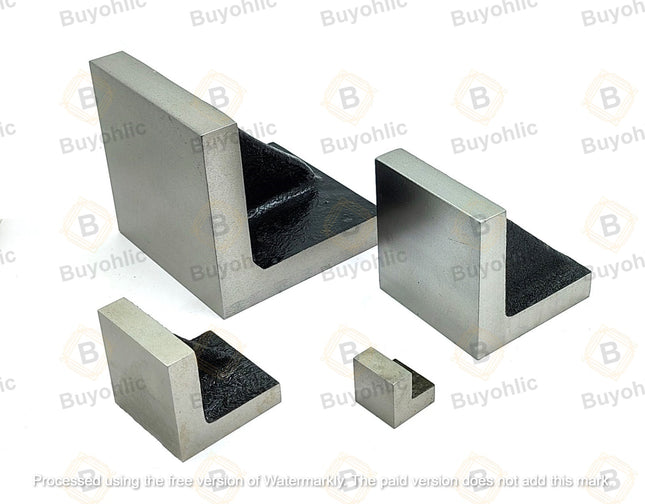
An angle plate is a precision workholding and setup tool machined to an exact 90-degree angle between its two main faces. The two faces are ground flat and square to each other so that when one face sits on the machine table or surface plate, the other face provides a perfectly vertical reference surface at exactly 90 degrees to the table. This makes angle plates essential for setups where a workpiece needs to be held vertically for machining, drilling, or grinding, and for inspection setups where squareness of machined surfaces needs to be verified.
Buyohlic angle plates are available in both solid webbed cast iron and slotted configurations for different workholding needs. Cast iron provides excellent vibration damping and thermal stability, making it the preferred material for precision angle plates used in milling and grinding. Slotted angle plates have T-slots or drilled holes in the vertical face for clamping workpieces directly to the plate surface, which is essential for holding parts vertically during end milling and drilling operations where a vise cannot provide the required orientation.
Angle Plate Applications in Machine Shop Work
The most common use of an angle plate in a milling operation is holding a workpiece vertically so that a horizontal face on the part can be milled while the part is oriented with that face pointing up. For example, milling a slot across the end face of a shaft requires the shaft to be held vertically. The shaft is clamped to an angle plate, the angle plate is bolted to the milling machine table, and the mill can now access the shaft end face with a standard end mill or face mill.
In inspection work, angle plates are used on surface plates to verify the squareness of machined surfaces relative to datum faces. A dial test indicator sweeping across a machined face while the part is referenced against an angle plate measures the squareness error quickly and accurately.
In drilling operations, angle plates hold cylindrical and irregularly shaped parts at 90 degrees to the drill press table so that a hole can be drilled into the side face of the part. Combined with vee blocks for round parts, angle plates provide the stable vertical reference needed for precise side drilling.
Angle Plate Types and Specifications
- Solid webbed angle plates: Simple L-shaped plates with flat faces, used where no clamping features on the plate are needed because the workpiece is clamped against the plate from another direction
- Slotted angle plates: Have T-slots or holes in the vertical face for clamping straps and bolts, used for clamping workpieces directly to the plate surface
- Adjustable swivel angle plates: Can be tilted to angles other than 90 degrees for angular drilling and milling operations
Pair angle plates with clamping tools for securing workpieces to the plate surface, and with vee blocks for holding round stock at the correct angle for side drilling and milling.
Frequently Asked Questions - Angle Plates
An angle plate provides a precision 90-degree reference surface for holding workpieces vertically on machine tables and surface plates. It is used for milling end faces and side features that require the part to be held upright, for drilling holes in the side faces of parts, for grinding operations requiring vertical workpiece orientation, and for inspection setups verifying squareness of machined surfaces.
A solid webbed angle plate has flat faces without mounting slots, providing maximum rigidity and thermal stability for precision reference work. A slotted angle plate has T-slots or holes in the vertical face for clamping workpieces directly to the plate. For workholding in milling and drilling operations where the workpiece is clamped to the plate face, a slotted plate is required. For pure reference and inspection use, the solid webbed plate is preferred for its greater rigidity.
Quality precision ground angle plates are ground to squareness tolerances of 0.0005 inch per foot or better on both the horizontal base and vertical face. The face flatness is typically ground to within 0.001 inch across the full face area. This level of accuracy is adequate for the vast majority of milling, grinding, and inspection operations in a general-purpose machine shop.
Choose an angle plate size based on the largest workpiece you regularly need to hold. The workpiece should fit comfortably on the vertical face with space for clamping hardware. Common sizes for general machine shop use range from 4x4 inches to 12x8 inches. For inspection on a surface plate, a mid-size plate of 6x6 inches suits most part sizes. For large part milling, select a plate whose vertical face height exceeds the height of the feature being machined.


