

The Best Lubrication Tools for CNC and Manual Machine Shops
- , by Mani Bhushan
- 21 min reading time
Every machine tool failure has a story. And in most of those stories, the ending was the same: the right lubricant wasn't applied at the right time. This guide is for machinists who don't want to learn that lesson the expensive way.
Whether you're running a VMC shop in Ohio or a manual Bridgeport in your garage in Texas, lubrication is the single cheapest maintenance task you can do and the most skipped. A $12 oil can used daily saves $4,000 on a ball screw replacement. A $35 grease gun used weekly saves a $1,200 bearing. The math is embarrassingly simple.
This guide walks through every lubrication tool a CNC or manual machine shop actually needs, what each one does, where it goes on your machine, and which products from Buyohlic's lubrication tools collection ship fast from our US warehouse.
73%
of premature machine tool bearing failures in small US machine shops are caused by inadequate or incorrect lubrication, not by overloading or operator error. The fix costs less than a decent dinner out.
01 Why Lubrication Is Your Most Profitable Shop Habit
Let's be honest about something. Most machinists know they should lubricate their machines every day. Most don't. Not because they don't care, but because the right tools aren't laid out and ready, or because the task feels vague and unclear.
Here's what actually happens inside your machine when it runs dry:
- Slideways and guideways: the metal-on-metal contact generates heat and microscopic abrasive particles. Within weeks, the fit between your saddle and bed opens up, giving you backlash and chatter you can't tune out
- Ballscrews: the balls begin to skid rather than roll. You lose positioning accuracy first, then the screw starts making noise, then you're looking at a $2,000–$5,000 replacement
- Spindle bearings: the most expensive single failure in any CNC machine. A spindle rebuild on a VMC in the USA typically runs $3,000–$8,000 in parts and labor
- Leadscrew threads on manual machines: bronze nuts wear fast without oil. Once the backlash exceeds 0.010", your thread pitch is affected, and every threaded operation is suspect
The right lubrication tools make this a 5-minute daily routine instead of an overwhelming chore. Let's go through each one.
02 Grease Guns: For Zerk Fittings and Sealed Bearings
The grease gun is the most immediately recognizable lubrication tool in any machine shop. Its job is simple: force grease through a Zerk fitting (also called a grease nipple) into a sealed bearing housing, spindle bearing, or joint that cannot be reached with an oil can.
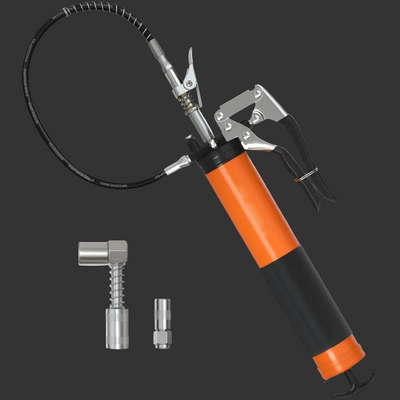
Buyohlic Lubrication Tools
Precision Greasing Guns
Heavy-duty lever-action and pistol-grip grease guns for controlled delivery through standard Zerk fittings. Essential for VMC bearings, rotary table maintenance, tailstock barrels, and any grease nipple on your machine. Ships from our US warehouse.
Shop Greasing Guns →
Where does the grease gun go on your machine? Look for any small hemispherical dome on your machine, usually brass or steel with a small hole in the center. That's a Zerk fitting. On a typical manual lathe or Bridgeport mill, you'll find them on:
- Rotary table bearing housings
- Tailstock barrel and quill mechanism
- Chuck back-gear housings (on older belt-head machines)
- Column pivot points and knee gibs on knee mills
- Universal joint drive shafts
- Ball handle joints on handwheels
Pro tip: On VMC machines, the spindle manufacturer specifies both the grease type (usually a specific bearing grease, often lithium-based) AND the quantity per re-greasing interval. Over-greasing a spindle bearing is just as damaging as under-greasing; excess grease churns in the bearing, generating heat. Always follow the spindle manual, not general advice.
For most shop Zerk fittings, a standard lever-action or pistol-grip grease gun with a standard coupler is the right choice. Use a flexible extension hose for fittings in awkward locations. Buyohlic's flexible hose pipes are specifically designed for this.
03 Oil Cans: The Most Used Tool in Any Machine Shop
If you only buy one lubrication tool, make it an oil can with a flexible spout. Not because it's the most glamorous piece of equipment in your shop, it very much isn't, but because it does the most work, most often, on the surfaces that matter most.
The oil can is how you reach the lathe bed slideways, the milling machine knee, the saddle ways, the tailstock barrel, and the cross-slide. These are the surfaces your machine runs on all day, every day. They need oil before every single use, not weekly, not monthly. Every day. Before you start.
⚠ The WD-40 Trap: WD-40 is not a lubricant. It's a water displacement spray that evaporates within hours and leaves almost no protective oil film. Using WD-40 on slideways or leadscrews gives you about 45 minutes of "lubrication" before the surface is effectively dry. Use proper machine oil from an oil can. ISO VG 68 way oil is the standard for most manual machine slideways.
What to look for in a shop oil can:
- Flexible or extendable spout: to reach the slideways under the saddle and between machine components without contorting yourself
- Metal body: plastic cans crack in shop environments and contaminate the oil with debris over time
- Capacity between 250ml and 500ml: large enough to do all your machines on one fill, small enough to handle easily
- Sealed cap: open cans in a machine shop, collect swarf and chips. Even a small amount of metallic contamination in your oil can scratch the same surfaces you're trying to protect
Buyohlic Oil Cans US Warehouse
Shop Oil Cans →
Precision-tip oil cans for lathe slideways, milling machine ways, and all machine lubrication points. Free shipping on all orders.
04 Rotary Barrel Pumps: For Shops That Go Through Serious Oil Volume
If you have three or more machines and you're buying oil by the gallon or, better yet, by the drum, you need a rotary pump. Trying to fill an oil can from a 5-gallon bucket by tipping it over is a guaranteed oil spill and a back injury waiting to happen.
A rotary barrel pump (also called a drum pump or hand rotary pump) sits on top of your oil drum or bucket. One or two rotations of the handle draws oil up through the suction tube and out the spout directly into your oil can, funnel, or machine sump. Clean, controlled, no spills, no tipping a 35-pound bucket.
Why this matters for your operation specifically: If you're running a US machine shop and buying ISO VG 68 way oil in 5-gallon containers, a rotary pump pays for itself in the first month, in time saved and oil not spilled on your floor. It's the kind of tool that once you have it, you wonder how you ever worked without it.
Buyohlic Rotary Pumps
Shop Rotary Pumps →
Hand-operated rotary barrel pumps for clean, controlled oil transfer from drums and containers. No spills, no lifting.
05 Foot-Operated Grease Pumps: For High-Volume Production Shops
Once your shop gets busy enough that you're lubricating multiple machines multiple times per day, the hand-lever grease gun starts to slow you down. A foot-operated grease pump solves this by moving your hands off the pump entirely. You pump with your foot while your hands position the coupler on the Zerk fitting.
This is standard equipment in automotive service shops, industrial maintenance departments, and any machine shop that has five or more grease points to service on each shift. It's faster, more consistent, and reduces hand fatigue on high-volume greasing tasks.
Buyohlic Foot Operated Grease Pumps
Shop Foot Pumps →
Hands-free grease delivery for production shops. More consistent output, faster servicing of multiple machines.
06 Flexible Hose Pipes: Because Some Fittings Are in Impossible Places
There's always that one Zerk fitting. The one behind the column. The one under the knee. The one that whoever designed this machine clearly never intended anyone to actually reach with a normal grease gun coupler.
A flexible extension hose for your grease gun solves this problem completely. The flexible hose threads onto your grease gun in place of the rigid coupler, bends around any obstruction, and positions the coupler exactly where you need it. For machines with tight clearances, such as VMC tailstocks, rotary table pivot bearings, and knee mill gibs, a flexible hose is not optional; it's essential.
Buyohlic Flexible Hose Pipes
Shop Flexible Hoses →
Grease gun extension hoses for hard-to-reach Zerk fittings. Fits standard grease gun threads.
07 Air Dust Guns: Clean Before You Lube, Every Single Time
Here's one that most machinists don't think of as a "lubrication tool," but it absolutely is. Applying oil or grease to a surface covered in chips, swarf, or coolant residue is not lubrication. It's contamination. You're mixing abrasives directly into the lubricant film between your machine's most precise surfaces.
The correct lubrication routine is always: blow off first, then wipe, then oil. An air dust gun makes the blow-off step fast, thorough, and effective. You can clear an entire lathe bed and saddle in 30 seconds flat, getting into every crevice, under every way wiper, around every cover before your oil can touch the surface.
Beyond lubrication prep, an air dust gun is one of the most-used tools in any machine shop: clearing chips from vise jaws, blowing out tapped holes before inspection, cleaning measurement tools before use, and clearing swarf from T-slots before mounting a vise. Every machine shop with compressed air needs at least one.
Buyohlic Air Dust Guns
Shop Air Dust Guns →
Precision air blow guns for chip clearing, lubrication prep, and general machine shop cleaning. Essential daily-use tool.
08 Polyethylene Funnels: The Overlooked Essential
Nobody writes enthusiastic blog posts about funnels. But every time you top up a coolant sump, refill a machine gearbox, or transfer oil without one and you spill half of it on the floor, you think about funnels.
Polyethylene funnels are oil-resistant, chemical-resistant, and don't react with machine coolants or way oils the way standard plastic can. They're flexible enough not to crack when dropped, and they come in sizes that fit standard machine fill ports. Keep three sizes in your shop: small for oil cans, medium for machine sumps, and large for coolant top-ups.
Buyohlic Polyethylene Funnels
Shop Funnels →
Chemical-resistant funnels for clean oil and coolant transfer. Sized for machine shop use.
09 Quick Reference: Which Tool for Which Job
| Tool | What It Does | Where It's Used | Buyohlic Link |
|---|---|---|---|
| Grease Gun | Injects grease through Zerk fittings into sealed bearings and housings | Rotary table bearings, spindle housings, tailstock barrel, and knee mill pivot | Greasing Guns |
| Oil Can | Applies oil to open slideways, leadscrews, and exposed bearing surfaces | Lathe bed ways, saddle, cross-slide, milling machine knee, tailstock quill | Oil Cans |
| Rotary Pump | Transfers oil from drums/containers to oil cans without spilling or lifting | 5-gallon oil drums, coolant containers, and large lubricant storage | Rotary Pumps |
| Foot Grease Pump | Hands-free grease pumping for high-volume multi-point greasing | Production shops with 5+ grease points per machine per shift | Foot Pumps |
| Flexible Hose Pipe | Extends grease gun reach to inaccessible Zerk fittings | Hard-to-reach fittings on VMC, rotary tables, and knee mill column | Hose Pipes |
| Air Dust Gun | Clears chips and debris before lubrication and between operations | Machine ways, vise jaws, tapped holes, T-slots, tool holders | Air Dust Guns |
| Polyethylene Funnel | Clean, spill-free transfer of oil and coolant into machine sumps | Coolant sump top-up, gearbox oil fill, oil can refilling | Funnels |
10 The Machine Shop Lubrication Schedule (Print This Out)
The most common question we get: "How often do I actually need to do this?" Here's a practical schedule based on typical US machine shop usage. Always cross-reference your machine's own manual; these are general guidelines.
Daily
Slideway and guideway oil — Oil can
Before starting the machine every day, apply ISO VG 68 way oil to all exposed slideways, cross-slides, saddle, knee (on knee mills), and tailstock barrel. This is the highest-impact lubrication task in any shop. Takes 3–5 minutes. Skipping this is how you ruin a $15,000 machine.
Daily
Blow-off before oiling — Air dust gun
Before applying any oil, blow chips and coolant residue off all surfaces to be lubricated. Oil applied over chips becomes a lapping compound. Thirty seconds with the air gun before the oil can makes every subsequent lubrication task more effective.
Weekly
Leadscrew and ballscrew lubrication — Oil can or auto-lube
On manual machines, oil the leadscrew threads by running the carriage across the full length while applying oil from the can. On CNC machines, verify the auto-lubrication system reservoir is filled, and the pump is cycling correctly. A Low reservoir on a CNC auto-lube is a silent ballscrew killer.
Weekly
Rotary table bearing grease — Grease gun
If your rotary table has a Zerk fitting (most do), apply 1–2 pumps of the manufacturer-specified grease weekly on a lightly used table, daily in production. Over-greasing here is far less damaging than under-greasing.
Monthly
All Zerk fittings inspection — Grease gun + flexible hose
Do a full walk-around of every machine. Find every Zerk fitting on the machine — some are hidden behind covers or panels. Apply grease to any fitting that accepts it. Check that no fittings are blocked or missing. Replace any blocked fitting with a new one before the next maintenance cycle.
Per 500 hrs
Spindle bearing grease — Grease gun — FOLLOW MANUAL EXACTLY
The spindle re-greasing interval and grease quantity are specified by the spindle manufacturer and must be followed precisely. Too much or too little grease here causes premature bearing failure. Refer to your machine manual. This is the one lubrication task where "more is better" does NOT apply.
11 Build Your Lubrication Station: A Simple System That Actually Gets Used
Here's the real reason most shops don't lubricate consistently: the tools aren't organized and ready to use. If the oil can is on a shelf across the shop, under three other things, in a cabinet that's hard to open, it won't get used. Full stop.
The most effective lubrication systems in US machine shops are those in which the tools are on the machine. A small pegboard or tool rack beside each machine holding an oil can, a rag, and (if needed) a grease gun makes daily lubrication take less thought than making coffee.
Set yours up this way:
- Oil can: At every machine, filled and ready. Use Buyohlic oil cans with a flexible spout for hard-to-reach slideways
- Grease gun: One per shop area (or one per machine if you have the budget). Pair with a flexible hose for tight fittings
- Air dust gun: At every machine. The first step before every lubrication task. Shop our air dust guns
- Rotary pump: At your oil storage area. Makes refilling oil cans a 20-second job. Shop our rotary pumps
- Funnels: Kept with your coolant and oil drums. Shop our polyethylene funnels
The complete Buyohlic lubrication tools range ships from our US warehouse with free shipping on all orders. If you're building out your shop's maintenance setup, this is the right place to start and the investment that protects every other tool purchase you've already made.
Frequently Asked Questions
How often should I lubricate a CNC milling machine?
What type of oil should I use on a manual lathe or milling machine?
What is a grease gun used for in a machine shop?
Can I use WD-40 as a machine lubricant?
What is a rotary pump used for in machine shop maintenance?


Great Value
Most popular brands with widest range of selection at best prices.

Nationwide Delivery
Over 20,000 pincodes serviceable across India.

Secure Payment
Partnered with India's most popular and secure payment solutions.

Buyer Protection
Committed to buyer interests to provide a smooth shopping experience.