







Clamping is the operation that holds your workpiece in position during machining. It is one of the most underappreciated aspects of precision work because when it is done correctly, nothing interesting happens. The part stays exactly where it was placed, every cut goes exactly as planned, and the finished part measures exactly what the drawing calls for. When clamping is done incorrectly, the workpiece moves during cutting, features are machined in the wrong location, or the workpiece lifts from the table and becomes dangerous.
Buyohlic's clamping tools collection provides the hardware for securing workpieces directly to milling machine tables, drill press tables, and surface plates when a vise is not the right workholding method. Large or irregularly shaped parts that cannot be held in a vise, parts that need to be machined over their full top surface without vise interference, and parts where specific features need to be clamped close to the cutting zone all require direct table clamping with a proper clamp kit.
Clamp Kit Components and Their Functions
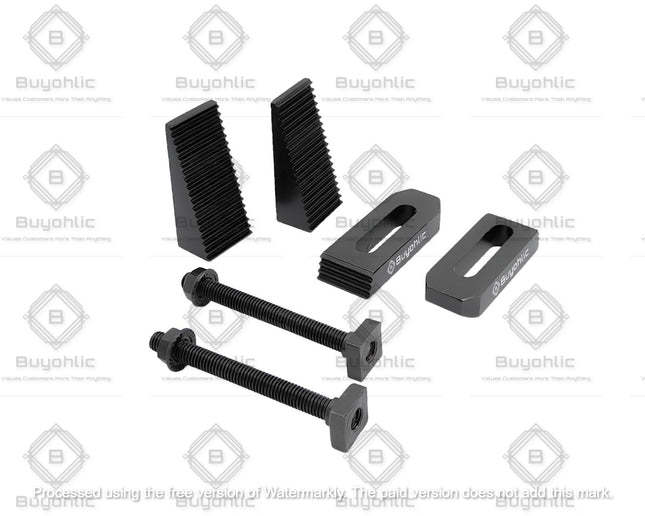
A complete clamping kit for milling machine work contains T-slot bolts that fit the T-slots in the machine table, step blocks in matched pairs that support the strap clamp at the correct height, strap clamps that span from the workpiece to the step block transferring the clamping force, and hex nuts with washers for tightening the assembly. The step blocks must be at the same height as the workpiece or slightly higher so the strap clamps apply downward force to the workpiece rather than levering it upward.
Toolmaker's parallel clamps are hand-tightened clamps with two parallel jaw faces and two clamping screws. They are used for holding two parts together during assembly work, for clamping parts to an angle plate, and for any workholding situation that benefits from the parallel jaw geometry. Their compact size allows them to be used in locations where standard strap clamps would interfere with the cutting tool or fixturing.
G-clamps and C-clamps provide general-purpose clamping force for holding workpieces to drill press tables, for assembly work, and for securing fixtures to machine tables during setup. They are the most versatile type of clamp in a general workshop and every machine shop keeps a range of sizes for varied clamping tasks.
Clamping Best Practices
- Always clamp as close as practical to the cutting zone to minimize the cantilever leverage that cutting forces apply to the workpiece
- Step blocks must be at the same height as or slightly higher than the clamping surface on the workpiece
- Use multiple clamp points for large workpieces to distribute clamping force and prevent rocking
- Always verify that clamp hardware is below the cutting tool path before starting the spindle
- Use soft jaw material (aluminum, brass, or plastic) between the clamp and finished surfaces to prevent marring
For milling workholding in a vise, see our precision milling vises. For angular setups, see angle plates. For milling tools, see our milling tools collection.
Frequently Asked Questions - Clamping Tools
A step clamp system consists of a T-bolt that fits the machine table slot, a strap that spans from the workpiece to a step block, and the step block itself which supports the strap at the correct height. Tightening the nut pulls the strap down onto the workpiece surface, clamping it to the table. The step block must be at the same height as the workpiece surface being clamped. If the step block is lower than the workpiece, the strap levers up instead of pressing down, which is incorrect and unsafe.
For a small workpiece under 6 inches, two clamps on opposite sides provide adequate restraint for most milling operations. For larger parts, use four clamps at the corners or distribute them evenly along the workpiece length. For operations involving heavy face milling where significant vertical forces are generated, add additional clamp points to prevent the part from lifting. The rule of thumb is to use the minimum number of clamps that prevents any movement, but to position them as close as practical to the cutting zone.
G-clamps and C-clamps refer to the same type of tool. The C-clamp name comes from the C-shape of the body frame. G-clamp is the British English term for the same tool. Both names are used interchangeably in American workshops. The tool has a fixed jaw at the bottom of the C frame and a screw-actuated movable foot at the top, which is tightened to clamp the workpiece between the two contact points.
Clamp kits are designed around specific T-slot dimensions. Most Bridgeport-style mills and VMC machines in the USA use 5/8 inch or 16mm T-slots. Before purchasing a clamp kit, confirm your machine table T-slot width. The T-bolt head must fit the slot without rocking (too small) and without being too wide to enter (too large). Buyohlic clamp kits are available in the standard sizes that fit most American and imported milling machines.


