


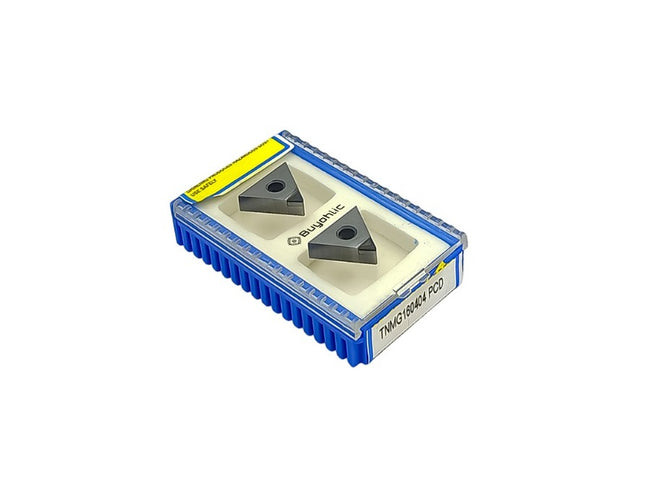


Carbide inserts tool are replaceable cutting components that play a critical role in the performance of turning tools, boring bars, milling cutters, and other CNC machining tools. As the actual cutting element, a carbide insert is manufactured from high-quality cemented carbide typically tungsten carbide bonded with cobalt and engineered with precise cutting geometries for specific machining applications.
Unlike solid cutting tools, carbide inserts can be indexed to a fresh cutting edge when worn or replaced entirely, restoring optimal cutting performance without removing the toolholder or resetting machine parameters. This reduces downtime, improves productivity, and lowers tooling costs.
At Buyohlic, we offer a comprehensive range of carbide inserts tool designed for CNC turning, milling, boring, and threading operations across a wide variety of materials and machining environments.
Carbide Insert Tool Applications
Buyohlic carbide inserts tool are suitable for:
- CNC Turning Operations
- Milling and Face Milling
- Internal Boring Applications
- Thread Cutting and Threading
- Profiling and Contour Machining
- Steel, Stainless Steel, Cast Iron, and Aluminum Machining
Our insert range includes the most commonly used ISO-standard geometries and grades found in modern machine shops.
Popular Carbide Insert Tool Types
CNMG, TNMG & DNMG Inserts
These negative-rake inserts are widely used for general-purpose turning of steel and cast iron. Their robust design provides excellent edge strength and long tool life during heavy machining operations.
DCMT & VCMT Inserts
Positive-rake inserts designed for light cutting forces, smooth finishes, and efficient machining of aluminum, stainless steel, and softer materials.
Face Mill Inserts
Used in face milling cutters to generate flat surfaces quickly and efficiently with excellent surface finish quality.
Boring Bar Inserts
Specifically designed for internal turning and precision boring applications where accuracy and stability are critical.
Threading Inserts
Ideal for producing external and internal threads in standard thread forms and pitches with consistent accuracy and repeatability.
Round Inserts
Commonly used for copy turning, profiling, and contour machining where smooth transitions and strong cutting edges are required.
Square Inserts
Popular in face milling and shoulder milling applications due to their multiple cutting edges and high material removal capability.
Understanding Carbide Insert Tool Designation Codes
Carbide inserts follow an ISO coding system that identifies their shape, clearance angle, tolerance, chipbreaker style, size, thickness, and corner radius.
For example:
CNMG 120408
- C = 80° Diamond Shape
- N = 0° Clearance Angle (Negative Rake)
- M = Medium Tolerance Class
- G = Chipbreaker Groove
- 12 = 12 mm Inscribed Circle
- 04 = 4 mm Thickness
- 08 = 0.8 mm Corner Radius
Understanding these codes helps machinists quickly identify the correct insert for a specific toolholder and machining application.
Choosing the Right Carbide Insert Tool Grade
Selecting the correct insert grade is just as important as choosing the proper geometry.
P Grade – Steel Machining
Designed for carbon steels and alloy steels, offering excellent wear resistance and toughness.
M Grade – Stainless Steel
Optimized for stainless steels and difficult-to-machine materials where heat resistance is essential.
K Grade – Cast Iron
Ideal for cast iron applications requiring high wear resistance and edge stability.
N Grade – Non-Ferrous Materials
Engineered for aluminum, copper, brass, and other non-ferrous metals, delivering superior surface finishes.
H Grade – Hardened Materials
Suitable for machining hardened steels and materials above 45 HRC hardness.
Benefits of Carbide Inserts Tool
- Fast and easy insert replacement
- Reduced machine downtime
- Consistent cutting performance
- Multiple cutting edges per insert
- High wear resistance and tool life
- Suitable for high-speed CNC machining
- Cost-effective tooling solution
Whether you're performing rough turning, finish machining, boring, milling, or threading, Buyohlic carbide inserts provide the precision, durability, and performance needed to maximize machining efficiency.
For the toolholders that use these inserts, see our turning tool holders and boring bars. For complete CNC tooling, see our CNC and VMC machine tools collection. For HSS alternatives, see HSS cutting tools.
Frequently Asked Questions - Carbide Inserts
A carbide insert is used for cutting, turning, milling, boring, and threading operations in machining. Buyohlic carbide inserts deliver precision, durability, and consistent performance on various materials.
Signs that indicate a dull or worn cutting edge include: increasing surface roughness on turned parts, dimensional drift (parts getting larger or smaller than programmed), increased cutting forces felt as chatter or vibration, visible edge wear or chipping when inspecting the insert with a magnifier, and burning or discoloration on the workpiece surface. Index to the next unused edge at the first sign of these symptoms rather than running the insert until it catastrophically fails, which can damage the toolholder seat.
The same ISO code guarantees the same basic geometry and dimensional envelope, so a CNMG 120408 from any ISO-compliant manufacturer fits the same holder pocket. However, the grade coating, substrate quality, and chip breaker geometry vary significantly between manufacturers and even between product lines from the same manufacturer. Premium insert grades from major manufacturers generally provide longer tool life and more consistent performance than budget inserts of nominally the same designation.
Yes, carbide inserts have value due to their tungsten carbide content. Even worn inserts can often be recycled. Buyohlic carbide inserts provide excellent value through long tool life and reliable machining performance.
Carbide prices are influenced by the cost of tungsten, manufacturing processes, and global demand. Despite the higher cost, Buyohlic carbide inserts offer superior durability and productivity, reducing overall machining expenses.
Carbide insert life varies by material, cutting speed, and application. Under proper conditions, Buyohlic carbide inserts can last significantly longer than HSS tools while maintaining cutting accuracy.
Round carbide inserts are generally considered the strongest because they distribute cutting forces evenly across the edge. Buyohlic offers round inserts for heavy-duty machining and profiling applications.
Most indexable carbide inserts are designed to be rotated or replaced rather than sharpened. Buyohlic carbide inserts feature multiple cutting edges, allowing quick indexing when an edge becomes worn.
Insert size depends on the toolholder, machining operation, and workpiece requirements. Buyohlic recommends matching the insert designation and dimensions to your toolholder specifications for optimal performance.


